The short answer
Most local businesses should have both a Google Business Profile and a website. A Google Business Profile is excellent for local discovery, especially when someone searches for your business name, your service, or a nearby provider. But it is not the same thing as owning a website.
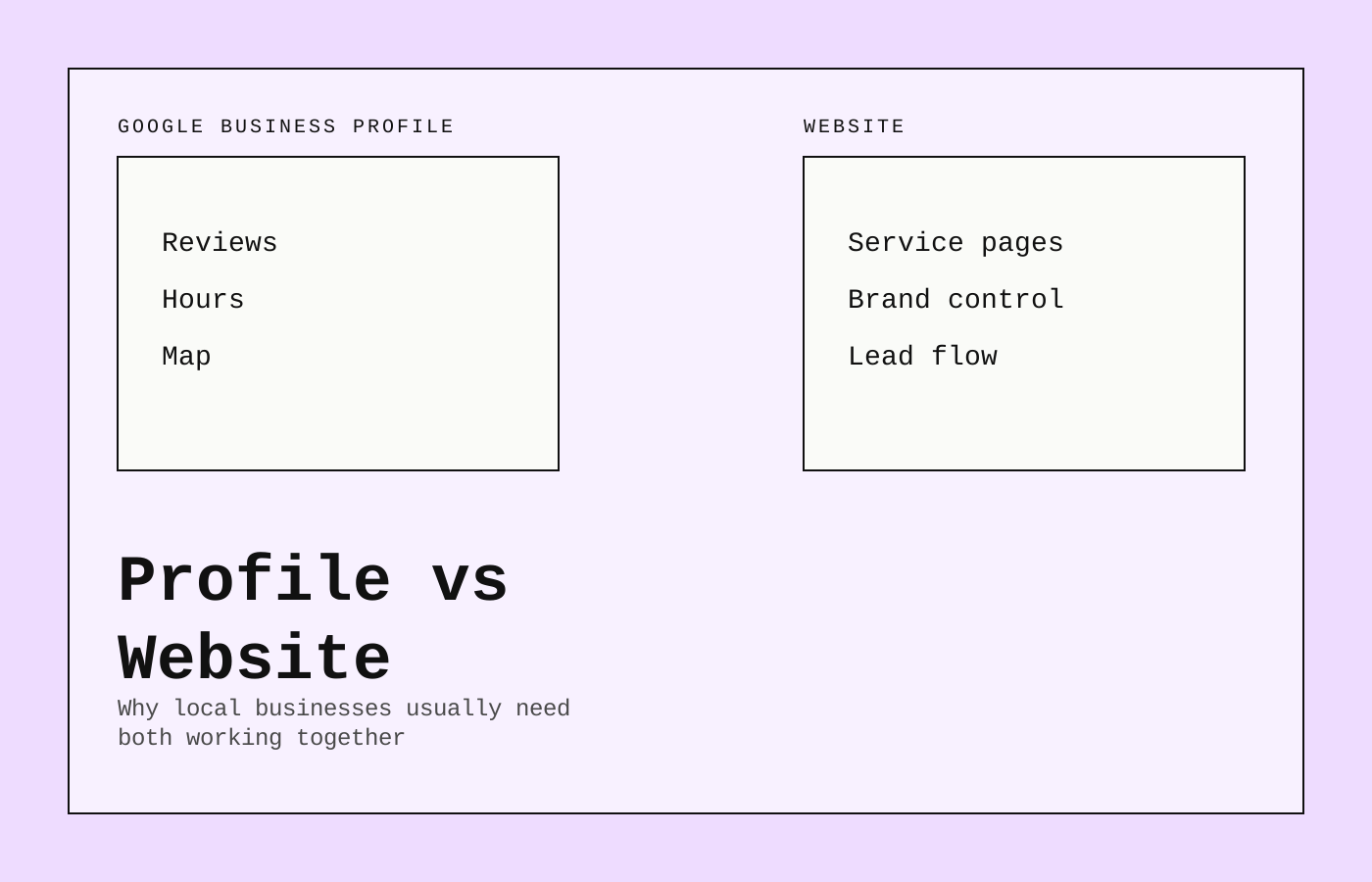
Your profile can show your phone number, hours, address, reviews, photos, and map placement. Your website can explain what you do in detail, show why you are credible, answer customer questions, rank for service-specific searches, and guide people toward calling, booking, or requesting a quote.
The cleanest way to think about it is this: a Google Business Profile helps people find you. A website helps people choose you.
Google Business Profile vs website: what each one is for
A Google Business Profile and a website should not compete with each other. They do different jobs in the same local marketing system. If you rely on only one, you usually leave visibility, trust, or conversion opportunities on the table.
Your Google Business Profile is a listing inside Google. Your website is a business asset you control. One is strongest for quick discovery. The other is strongest for depth, positioning, and conversion.
- Google Business Profile: best for maps visibility, reviews, hours, phone calls, directions, business categories, quick photos, and basic local discovery.
- Website: best for service pages, pricing context, project examples, before-and-after galleries, FAQs, detailed location content, brand positioning, intake forms, and stronger calls to action.
- Google Business Profile: controlled partly by Google, limited by Google fields, and shown inside a competitive search environment.
- Website: controlled by you, designed around your offer, and built to tell the full story of your business.
When a Google Business Profile may be enough
There are a few cases where a Google Business Profile can carry a business for a while. If you are very new, have almost no budget, provide a simple service, and only need basic local visibility, a profile is better than having no online presence at all.
A profile-only setup can also work temporarily for businesses that get nearly all of their leads from referrals, repeat customers, or walk-in traffic. In that situation, the profile mainly confirms that the business is real and gives people an easy way to call or get directions.
But profile-only should usually be viewed as a starting point, not the long-term plan. As soon as people begin comparing you against competitors, searching for specific services, or needing more confidence before they contact you, the limits show up quickly.
- A profile may be enough temporarily if your offer is simple and most customers already know what you do.
- A profile may be enough temporarily if you are testing a business idea before investing in a stronger online presence.
- A profile may be enough temporarily if your main goal is to appear on Google Maps and collect early reviews.
- A profile is usually not enough if customers need to compare services, trust your expertise, see examples, or submit detailed inquiries.
When you definitely need a website
A website becomes much more important when your business has multiple services, a competitive local market, higher-ticket work, or customers who need reassurance before they reach out. The more someone has to trust you before buying, the more your website matters.
This is especially true for service businesses like contractors, med spas, salons, arborists, cleaning companies, law firms, consultants, home service providers, and wellness businesses. In those categories, customers rarely choose based on a map listing alone. They look for signs that the business is professional, responsive, and worth contacting.
- You offer multiple services that deserve their own explanations.
- You serve multiple cities or neighborhoods and want pages that speak to those areas.
- Your work is visual and customers want to see examples before contacting you.
- Your service is expensive, personal, technical, or trust-heavy.
- Your competitors have better websites and look more established online.
- You want to collect leads through forms instead of only relying on calls.
- You want to rank for searches beyond your business name and map listing.
Why a website helps local SEO
A Google Business Profile can help you show up in local map results, but a website gives Google more crawlable context about your business. That context matters because Google needs to understand what you do, where you do it, and which pages are useful for searchers.
A strong local business website can support search visibility through page titles, meta descriptions, service pages, internal links, location content, FAQs, image context, and clear contact information. A profile gives Google a business listing. A website gives Google a deeper body of evidence.
That does not mean a website automatically makes you rank. Thin pages, generic copy, slow load times, and vague service descriptions will not do much. But a clear, useful website gives you opportunities a profile alone cannot provide.
- Service pages can target specific searches like roof repair, emergency plumbing, nail extensions, tree trimming, or facial treatments.
- Location content can explain the cities, suburbs, or neighborhoods you genuinely serve.
- FAQs can answer real customer questions before someone contacts you.
- Internal links can help visitors and search engines understand which services matter most.
- Clear page titles and descriptions help each page match a specific search intent.
What a website does for trust that a profile cannot
Trust is where the difference becomes obvious. A Google Business Profile can show reviews, but it cannot fully control how your business is presented. It cannot give you a custom homepage, a polished service page, a detailed process section, or a gallery designed around your best work.
A website lets you shape the first impression. You can explain who you help, what makes your business different, what the process looks like, what customers should expect, and why someone should choose you over the other businesses they saw in search results.
This matters because many people do not contact the first business they find. They open several options, skim reviews, look at photos, check websites, and choose the business that feels clearest and safest.
- A website can make a small business look established instead of unfinished.
- A website can explain your process so customers know what happens after they call.
- A website can organize reviews, project photos, FAQs, and service details in one place.
- A website can reduce doubt for customers who are comparing multiple providers.
What pages should a local business website include
You do not need a huge website to get value from one. For most local businesses, the goal is not to publish dozens of pages. The goal is to create the right pages: pages that help customers understand the business and take the next step.
A simple but strong local business website can start with a homepage, service pages, an about page, a contact page, and FAQs. From there, you can add galleries, location pages, blog posts, pricing context, or case-study style pages when they are genuinely useful.
- Homepage: explain what you do, who you serve, where you work, and what action people should take.
- Service pages: describe each important service clearly instead of hiding everything on one generic page.
- About page: make the business feel real and credible, especially if customers are hiring you into their home, body, finances, or business.
- Contact page: make calling, emailing, booking, or requesting a quote easy on mobile.
- FAQ sections: answer common objections about pricing, timing, service area, process, and what happens next.
- Gallery or work examples: show proof when visuals matter.
- Location pages: add these only when you genuinely serve multiple areas and can write useful, specific content for each one.
The risk of relying only on Google
Another reason to have a website is control. Your Google Business Profile lives on a platform you do not own. Google can change the interface, policies, categories, review display, messaging options, ranking signals, or how search results look.
That does not mean you should ignore your profile. You should absolutely keep it accurate, complete, and active. But it is risky to make a third-party listing your entire online presence. Your website gives you a stable home base that is not limited to whatever Google chooses to show in a search result.
A website also gives you somewhere to send people from business cards, social profiles, email signatures, QR codes, ads, directory listings, and referral conversations. Without it, every path leads back to a platform you do not fully control.
How Google Business Profile and your website work together
The best setup is not profile versus website. It is profile plus website. Your profile captures local discovery. Your website converts that attention into trust and inquiries.
A strong profile should link to a strong website. A strong website should reinforce the same business name, services, service area, phone number, and trust signals found on the profile. Consistency helps customers, and it also gives search engines clearer information about the business.
- Keep your business name, phone number, website URL, and service area consistent.
- Use your profile to collect reviews and keep core business details accurate.
- Use your website to explain services, show proof, answer questions, and capture leads.
- Add your website link to your profile so people can move from quick discovery into deeper research.
- Make sure your website loads quickly and works cleanly on mobile because many profile visitors will tap through from a phone.
How to decide what your business needs right now
If you are trying to decide whether to build a website now or wait, start with the customer journey. Ask what someone needs to believe before they contact you. If they only need hours and directions, a profile may carry more weight. If they need proof, explanation, comparison, or reassurance, a website becomes much more important.
For most serious local businesses, the practical answer is simple: keep the Google Business Profile, but do not stop there. Build a website that gives people enough confidence to take action.
- If customers ask the same questions before buying, your website should answer them.
- If customers compare you to competitors, your website should help you look clearer and more credible.
- If your services are searched individually, your website should have pages for those services.
- If your work is visual, your website should show examples in a polished way.
- If you want leads beyond map visibility, your website should become the center of your online presence.
Bottom line
A Google Business Profile is important, but it is not a full replacement for a website. Your profile helps with discovery. Your website helps with trust, clarity, local SEO, and lead conversion.
If you are just starting, a profile can be a useful first step. If you are trying to look professional, win more local customers, and compete against businesses that already have a strong online presence, you need both.
The strongest local businesses do not treat this as Google Business Profile vs website. They use the profile to get found and the website to get chosen.
Common questions
Do you need a website if you have a Google Business Profile?
Most local businesses should have both. A Google Business Profile helps people find your business in Google Search and Maps, while a website gives you more control over your services, proof, brand, FAQs, and lead conversion.
Is a Google Business Profile better than a website?
It is not better or worse because it does a different job. A profile is best for quick local discovery, reviews, hours, calls, and directions. A website is better for detailed service information, trust-building, search content, and forms.
Can a local business rank without a website?
Some local businesses can appear in map results with only a Google Business Profile, especially for branded or nearby searches. But without a website, you have fewer opportunities to rank for specific services, locations, FAQs, and comparison searches.
Can I get leads from just a Google Business Profile?
Yes, some businesses can get calls and direction requests from a Google Business Profile alone. The limitation is that profile-only leads usually depend on quick discovery, while a website helps convert people who need more information before contacting you.
What should I put on my website if I already have a Google Business Profile?
Start with a clear homepage, service pages, an about page, contact options, FAQs, reviews or testimonials, project photos if relevant, and a simple explanation of your service area and process.
Does having a website help local SEO?
Yes, a useful website can support local SEO by giving search engines crawlable service pages, location context, internal links, page titles, meta descriptions, FAQs, and clearer information about what your business offers.
Should my Google Business Profile link to my homepage or a service page?
For many local businesses, the homepage is the safest default because it explains the full business. If you run ads or have a very specific primary service, a focused landing page can also make sense as long as it is useful and trustworthy.